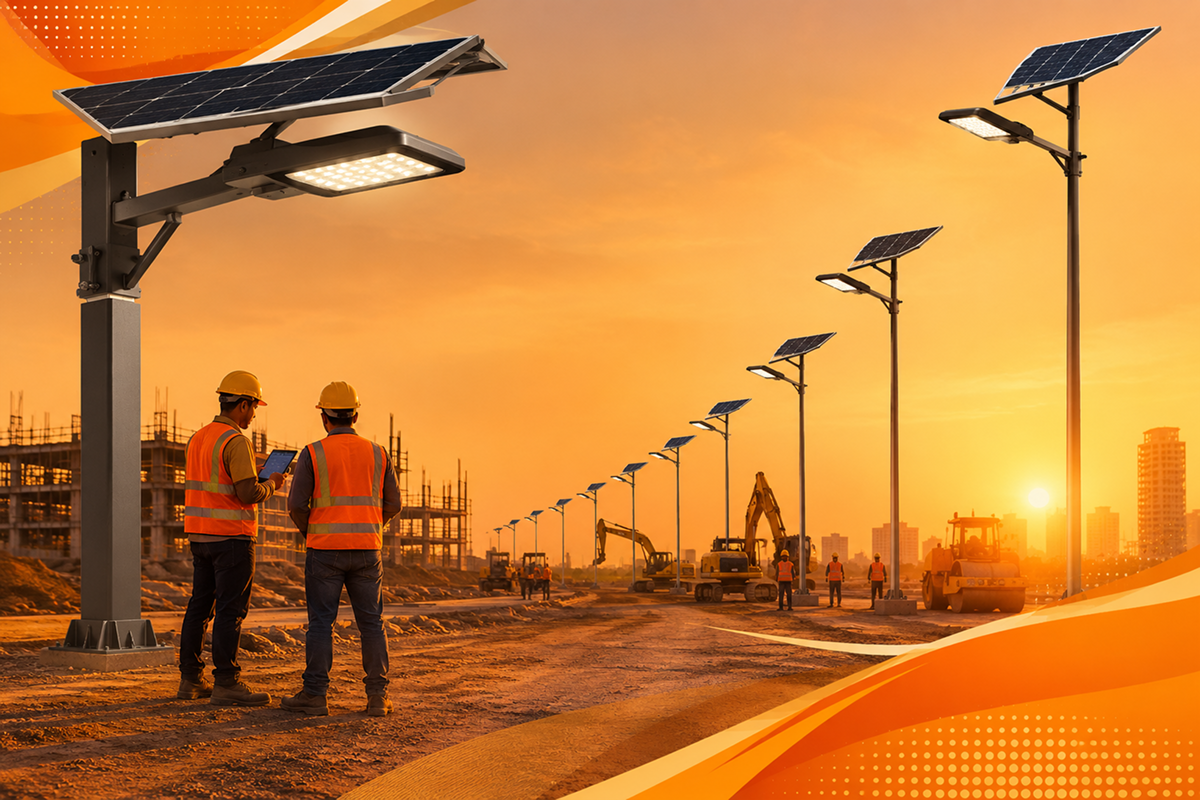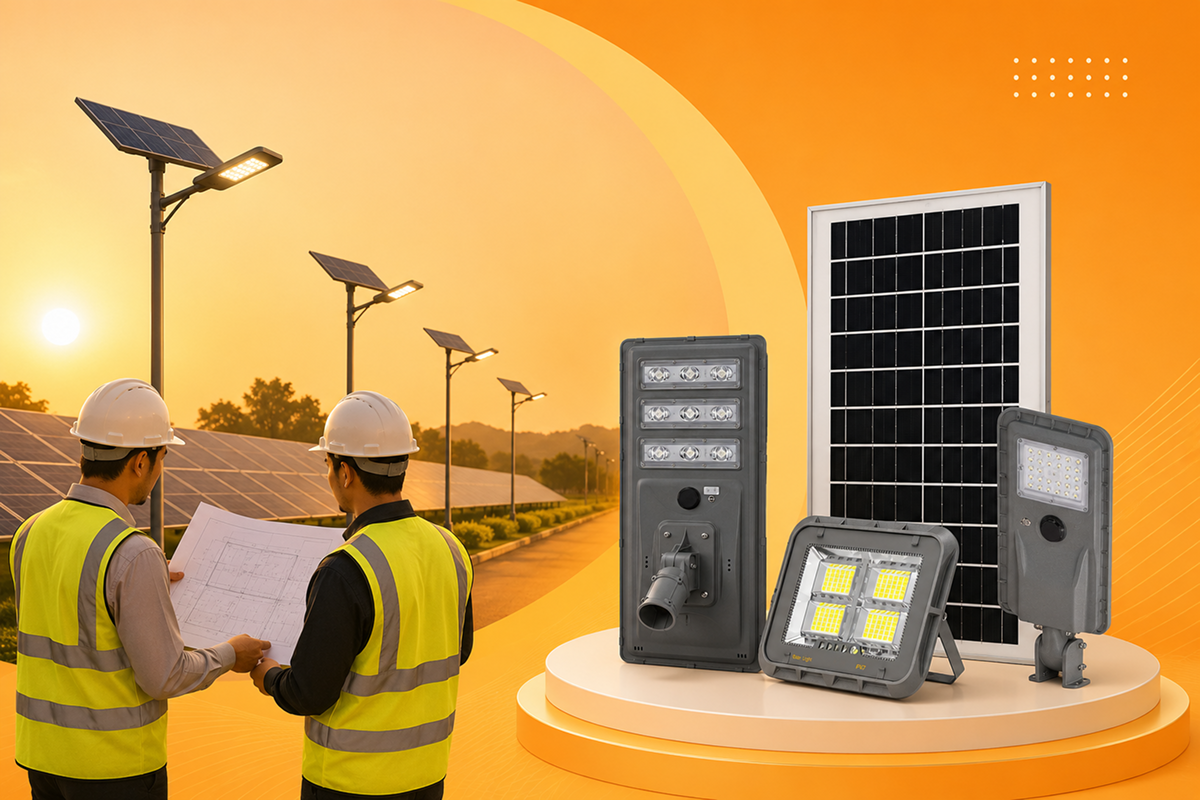
When lighting up roads, highways, parks and public areas, it is necessary to make appropriate planning while using solar street lighting as a perfect option for government and infrastructure projects. Public lights should have a uniform level of luminosity, withstand harsh weather conditions, and provide cost-efficient operation for several years. Whether your project involves roads, highways, streets, public parks, residential neighborhoods, or municipal grounds, the process starts with understanding the project’s specific requirements.
1. Assess the Project and Installation Site
Step one in deciding is to see where they will be placed; each area will have different requirements, and one type will not apply to all.
Consider:
- Road width and traffic levels
- Pole height and distance between poles
- Required lighting hours each night
- Average sunlight available at the location
- Weather and environmental conditions
- Required illumination and uniformity
A proper site assessment helps determine the appropriate LED power, solar panel capacity, battery size, and installation configuration.
2. Select the Right Solar Street Light Design
Solar street lights are generally available in two main designs: integrated systems and split-type systems.
Integrated systems are supplied with a solar panel, battery, LED module, and controller all in one body. Integrated units simplify installation for the user, and they are suitable for most streets, parks, pathways, and general public spaces.
Split-type systems have a separate solar panel and light fitting, offering more flexibility in panel positioning where shading, limited sunlight, or higher power requirements are concerns.
The best choice depends on the site’s sunlight exposure, available space, and project specifications.
3. Compare the Core Technical Specifications
Technical specifications should be carefully reviewed before approving a product for a large infrastructure project. Look beyond wattage and focus on overall system efficiency.
Important factors include:
- LED efficiency: Higher luminous efficacy can provide more light while using less energy.
- Battery technology: LiFePO4 batteries are widely preferred for solar applications because of their stability, safety, and long cycle life.
- Solar panel efficiency: Efficient panels can improve energy generation and battery charging.
- Lighting optics: Suitable beam distribution helps deliver uniform illumination across roads and public areas.
- Controller technology: MPPT controllers can improve solar energy harvesting under changing sunlight conditions.
4. Check Durability, Protection, and Certifications
Materials used on Government project devices need to cope with severe outdoor usage circumstances. Enclosures should withstand rain, dust, excessive heat, high humidity, and prolonged exposure to outdoor elements.
Before selecting a product, check for:
- Weather-resistant and corrosion-resistant housing
- Appropriate IP protection against dust and water
- Suitable impact protection
- Reliable thermal management
- Relevant product testing and certifications
- Clear warranty and after-sales support
Lighting calculations can also be performed using IES files and DIALux simulations. For road projects, IES files can be requested and simulations conducted in advance to evaluate lighting performance, pole spacing, and illumination uniformity.
5. Consider Smart Controls and Long-Term Costs
Solar street lights should provide reliable performance not only after installation but throughout their service life. They should be cost-effective to install and maintain throughout their life cycle. Smart controls may streamline the operations in a large networked lighting installation.
Depending on the system, additional functionalities such as remote monitoring, battery life monitoring, fault alerts, scheduled lighting, and centralized control might be provided. This enables less energy use for unwanted lighting, as well as quicker assessment of necessary repairs and maintenance.
6. Plan Installation and Maintenance for Long-Term Performance
Choosing the right solar street light is only one aspect of a successful infrastructure project.
Installation Requirements
During the installation, placement of the pole, direction of the panel, height for mounting, and connection of wiring shall be carefully planned. The purpose of installation is to collect as many sun rays as possible for the solar panel, and the radiation should fall onto the right area.
Maintenance and Spare Parts
Scheduled monitoring allows you to detect potential problems with batteries, LED modules, controllers, etc before they affect overall performance. In addition, choose the supplier that has access to supply and supports replacement and repair parts as needed.
7. Key Factors to Check Before Choosing a Solar Street Light
Review these important factors:
- Lighting performance
- Sunlight conditions and panel efficiency.
- Battery capacity
- Durability
- Consider remote monitoring, dimming, and fault alerts for larger projects.
- Safety standards, certifications, and project requirements.
- Review warranty terms
- Choose a supplier that can provide technical assistance and replacement components.
- Compare installation, maintenance, energy savings, and long-term operating costs, not just the initial purchase price.
Conclusion
In the case of governmental and infrastructure-related projects, the decision-makers will be required to select a system of solar street lights according to its light performance, durability, and the energy efficiency it can save, as well as based on external environmental conditions of the site together with total maintenance costs.
For project-specific solar street lighting solutions, technical specifications, and customized support, TedLighting can help government agencies, contractors, and infrastructure developers identify a suitable lighting system for their requirements.